Chat with Your Files: Why Local Document QA is a Game Changer
TL;DR
Local document QA lets you ask natural language questions across your private files without uploading them to the cloud. Dhito uses on-device LLMs with semantic chunking and context retrieval to provide cited answers from your PDFs, contracts, and research papers — 100% offline, with zero data exposure.
We've all been there: staring at a 120-page industry report, a complex legal contract, or a semester's worth of lecture slides, searching for a single piece of critical information. You press Ctrl+F or Cmd+F, but unless you match the exact phrasing, you are left scrolling through endless walls of text.
What if you could simply ask your files a question?
"What are the cancellation terms in this contract?" or "Summarize the key trends mentioned in section 4."
Chatting with files is one of the most powerful paradigms of modern AI, but until recently, it required uploading your private, sensitive data to third-party cloud servers.
Here is why local, private document QA is changing the way we work, and how Dhito is leading this transition.
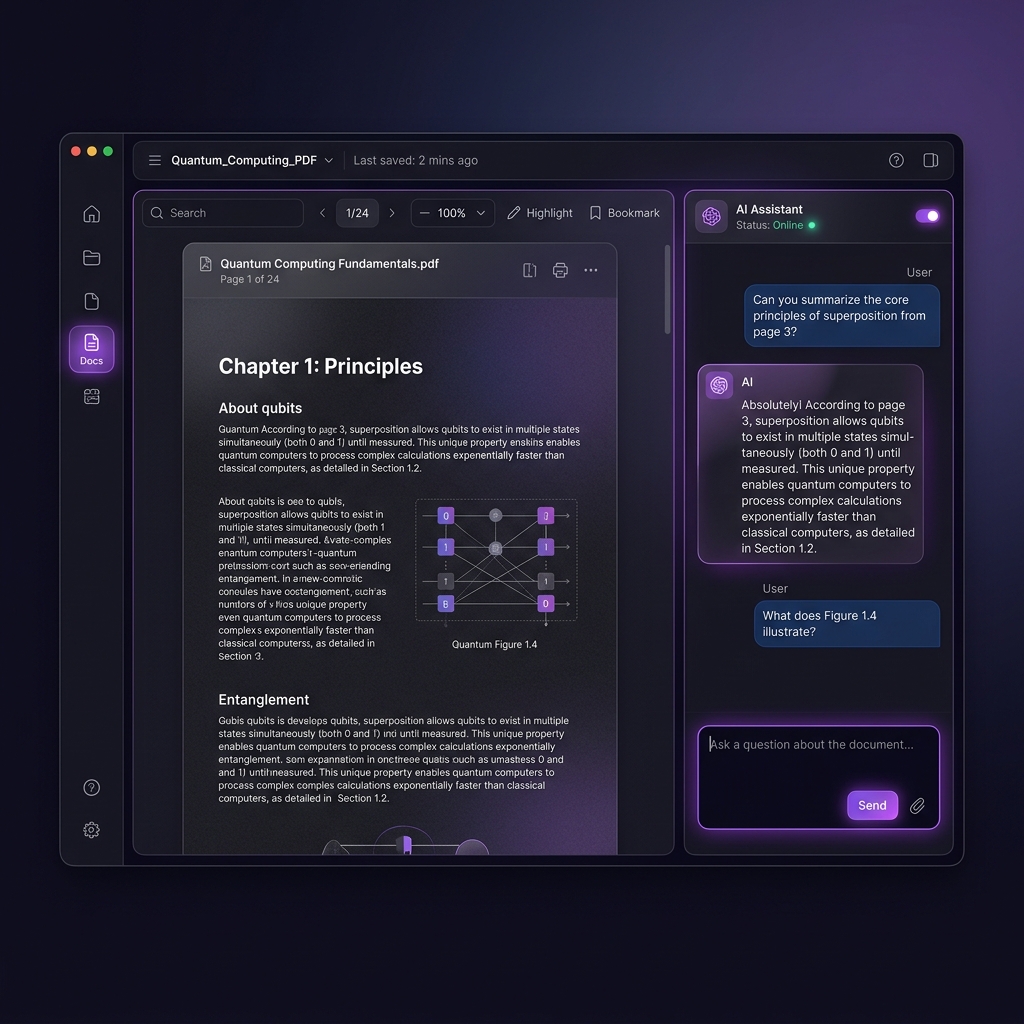
A modern dark mode UI showing a chat assistant answering questions about a PDF
The Cloud Problem: Privacy and Data Sovereignty
Using cloud-based AI tools like ChatGPT or Claude for document analysis is incredibly convenient, but it introduces massive compliance and privacy issues:
- Intellectual Property Leaks: Sending proprietary source code, unpublished research papers, or draft patents to the cloud can compromise your intellectual property.
- Sensitive Client Data: Medical files, client tax histories, or personal identity documents are subject to strict regulatory compliance (HIPAA, GDPR, CCPA). Uploading them violates data residency guidelines.
- Corporate Guidelines: Many enterprises have outright banned the use of public LLMs on work computers to avoid leaking confidential documents.
Enter Local Document QA
With local AI search and chat apps like Dhito, the paradigm is flipped. A local Large Language Model (LLM) runs entirely on your machine's CPU/GPU.
When you ask a question:
- Semantic Chunking: The document is broken down into small, meaningful passages.
- Context Retrieval: The query is vector-searched locally to find the most relevant passages.
- Local Synthesis: The local model synthesizes the answer using ONLY the retrieved chunks as context.
Your private documents never leave your computer, giving you state-of-the-art answers with zero data exposure.

Secure offline local AI processing microchip communicating with private documents
Why Chatting with Files is a Game Changer
Beyond privacy, interacting with your documents in conversational natural language changes the speed of information processing:
1. Instant Summarization
Instead of reading a 50-page PDF, ask: *"Summarize the three main conclusions of this research paper."* You get a bulleted summary in under 3 seconds.
2. Cross-Document Synthesis
You can select multiple files—such as three different financial quarters or competitor analyses—and ask: *"Compare the growth numbers across these reports."* The AI will synthesize information from multiple sources.
3. Citations & Verifiability
A major risk of AI is "hallucination"—making up facts. Because Dhito's chat references exact semantic chunks from your files, it can cite exactly which page and document it used to generate the answer. You can double-check the source with a single click.
4. Completely Offline
Whether you are on a plane, in a remote location, or experiencing internet downtime, local QA works 100% offline. You don't need a cellular signal or Wi-Fi connection to query your entire database of knowledge.
Conclusion
Chatting with your documents isn't just about saving time; it's about making your entire digital library active instead of passive. When your files can answer your questions, your productivity scales exponentially.
If you want to experience private, local document chat today, download Dhito and unlock the hidden knowledge on your hard drive.
Related Articles
GDPR, HIPAA, and the EU AI Act: Why Local AI is the Compliance Shortcut
Navigating AI compliance in 2026 is a legal minefield. Here is why the easiest way to comply with GDPR, HIPAA, and the EU AI Act is to simply not use the cloud at all.
What is RAG? How Retrieval-Augmented Generation Powers Private Document Chat
Ever wonder how an AI can instantly answer questions about a 500-page PDF it has never seen before? The secret is RAG. Here is a simple, no-code explanation of how it works.
Apple Intelligence vs. Dhito: What Apple's Built-in AI Gets Right (and What It Misses)
Apple Intelligence is transforming macOS, but is it enough for power users? We break down what Apple built-in AI does perfectly, and why you still need a dedicated local search engine like Dhito.
Want to try Dhito?
Download Dhito and experience the power of local semantic search today.